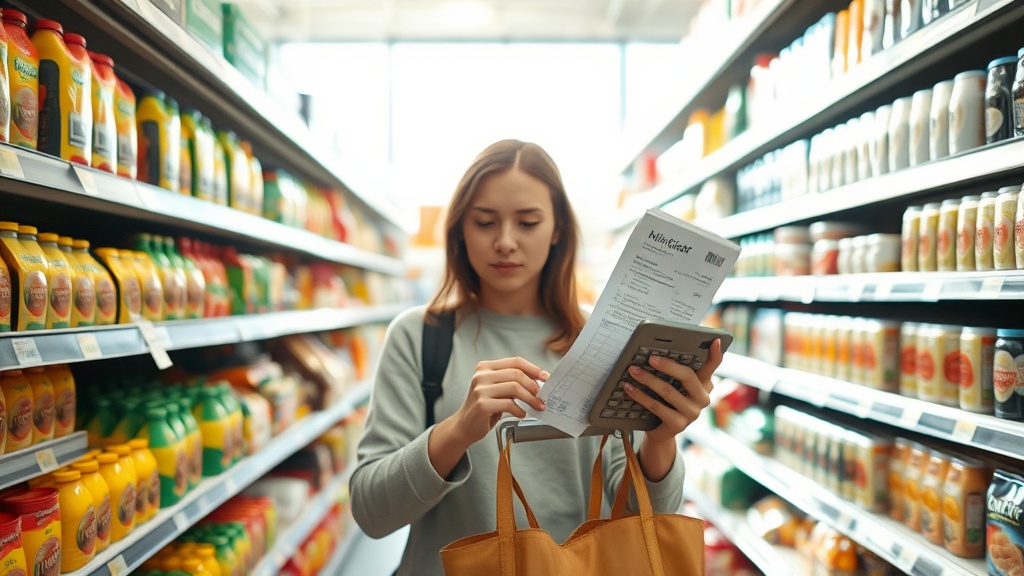
Unit‑Pricing Masterclass: How to Spot Real Grocery Deals in 2026

Unit‑Pricing Masterclass: How to Spot Real Grocery Deals in 2026
Ever walked down a grocery aisle, saw a “50 % off” sign, and still felt like you over‑paid? You’re not alone—most shoppers get duped by “sale” marketing that masks the real cost per ounce.
If you’ve ever tried to stretch a $30 grocery budget, you know the difference between a real deal and a flashy price tag. Cassidy Vance, former social worker turned budget‑health advocate, has built a spreadsheet‑heavy system that turns every product into a simple unit‑price comparison. This masterclass shows you how to apply that system today, in 2026’s inflated market.
What Is Unit Pricing and Why Does It Matter?
Unit pricing breaks a product’s price down to a common measure—price per ounce, per gram, per cup, etc. It lets you compare apples to apples, even when the packaging sizes differ.
- Real‑world example: A 16‑oz jar of generic tomato sauce costs $2.40, while a 24‑oz jar of a “premium” brand is $3.60.
- Unit price of generic: $0.15 / oz
- Unit price of premium: $0.15 / oz – identical!
- But the premium jar has added “organic” branding that adds no value for a tight budget.
Bottom line: The cheapest‑looking product often isn’t the cheapest per unit.
How Can You Quickly Calculate Unit Prices While Shopping?
1. What Tools Do I Need?
- Smartphone calculator (or the built‑in calculator app)
- Pen & paper (or a note‑taking app)
- A simple spreadsheet template — Cassidy’s free “Unit‑Pricing Spreadsheet” (download link below)
2. Step‑by‑Step Process
| Step | Action | Quick tip |
|---|---|---|
| 1 | Scan the shelf label for price and size. | If the size isn’t listed, ask an employee or check the back of the package. |
| 2 | Convert the size to a common unit (oz, g, ml). | Use Google “X oz to grams” for quick conversion. |
| 3 | Divide price by the converted size. | Example: $3.99 ÷ 24 oz = $0.166 / oz |
| 4 | Jot the result next to the product name. | Keep the list short—focus on the top 5 items you buy weekly. |
| 5 | Compare the numbers; pick the lowest. | If two items are within 5 ¢, choose the one you like more. |
3. Pro Tips
- Round to the nearest cent — it speeds up mental math.
- Use the “price per serving” on nutrition labels as a shortcut when the serving size matches your usual portion.
- Leverage store apps (Aldi’s “Aldi Finds”, Lidl’s “Lidl Plus”) — many now display unit prices automatically.
What Common Mistakes Inflate My Grocery Bill?
- Chasing “Buy One Get One” (BOGO) without unit‑price checks — The free item may be a larger, higher‑priced version that skews the total cost.
- Ignoring bulk‑size price drops — Not all bulk items are cheaper; always calculate the unit price.
- Relying on “sale” stickers — Retailers often raise the “regular” price weeks before a sale to make the discount look bigger.
Fix: Apply the unit‑price calculator to every “sale” item before you decide.
How Does This Fit Into a $2‑per‑Serving Meal Plan?
Cassidy’s $2‑per‑Serving recipe lab uses the same unit‑pricing logic. By selecting the cheapest protein, grain, and veg per unit, you can build a balanced meal for under $2.
- Protein: Canned beans (
$0.10 / oz) vs. fresh chicken breast ($0.25 / oz) - Grains: Bulk brown rice (
$0.04 / oz) vs. pre‑packaged rice bowls ($0.12 / oz) - Veggies: Frozen mixed veggies (
$0.06 / oz) vs. fresh organic packs ($0.15 / oz)
Result: A complete plate for $1.90, leaving room for spices and sauces.
Resources & Tools
- Download: Cassidy’s Unit‑Pricing Spreadsheet (Free) — pre‑filled with common grocery items.
- Read: How to Shop a Spring Farmer’s Market on a Tight Budget — applying unit pricing at markets.
- Watch: YouTube: “Unit Pricing 101 – Spotting Real Deals” — visual walk‑through.
- Data source: U.S. Bureau of Labor Statistics CPI — latest inflation rates.
- Research: Consumer Reports 2026 Grocery Price Study — benchmark prices across major chains.
- Authority: USDA FoodData Central — nutritional and cost data per unit.
- Analysis: USDA Economic Research Service – Grocery Price Outlook 2026 — industry‑wide price trends.
Takeaway
The next time you see a “50 % off” sign, pause, grab your phone, and run the unit‑price check. It’s a tiny habit that can shave $5‑$15 off a typical grocery bill each month—money you can redirect toward fresh produce, a gym membership, or a rainy‑day fund.
Ready to start? Download Cassidy’s spreadsheet, head to your local store, and put the math to work. Your wallet (and your health) will thank you.
Related Reading
- How to Shop a Spring Farmer’s Market on a Tight Budget — applying unit pricing at farmers’ markets.
- Zero‑Waste Batch Cooking: Maximizing Every Cent — stretching cheap ingredients.
- The $2‑per‑Serving Recipe Lab: Sample Menu — meal examples using low‑cost unit‑priced foods.
Steps
- 1
Gather Your Tools
- 2
Calculate Unit Prices