Your Freezer Is a Savings Account (And You're Leaving Money on the Table)

Your Freezer Is a Savings Account (And You're Leaving Money on the Table)
I need to talk about the most underrated appliance in your kitchen. Not the air fryer. Not the Instant Pot. Your freezer. The thing you're currently using to store mystery meat from 2024 and a half-eaten pint of ice cream.
When I was making $32k in Philly, my freezer was doing more financial heavy lifting than my actual savings account. I'm not exaggerating. A strategically managed freezer was saving me $80-120 a month—and I have the receipts to prove it.
The Math That Nobody Talks About
Here's the core equation: bulk price + freezer storage = unit cost destruction.
Let me break this down with real numbers from March 2026:
- Chicken thighs at regular price: ~$3.49/lb. On a manager's special markdown? $1.79/lb. Buy 5 lbs, freeze 4. You just saved $6.80 for the cost of a freezer bag.
- Bread: A loaf at $3.29 lasts maybe 5 days before it goes stale on the counter. Freeze half immediately and it lasts a month. You just cut your bread waste (and bread spending) by roughly 40%.
- Bananas at $0.59/lb turning brown? Don't throw them out. Peel, bag, freeze. That's smoothie base or banana bread starter for essentially free. The alternative is buying frozen fruit at $3.50-4.00/lb.
Add those up across a month and you're looking at $80+ in savings. That's not a wellness influencer fantasy number—that's what happens when you stop treating your freezer like a dumping ground and start treating it like infrastructure.
The Three Freezer Strategies That Actually Work
1. The Markdown Hunter
Every grocery store marks down meat and produce that's approaching its sell-by date. This is not sketchy food. It's perfectly good protein that the store needs to move. I hit ShopRite and Aldi every Thursday evening—that's when the markdown stickers come out in my area. Your store has a pattern too. Learn it.
The rule: if the markdown price beats your regular unit price by 30% or more, buy it and freeze it. Anything less and it's not worth the freezer real estate.
2. The Batch Cook and Bank
Sunday cooking isn't just meal prep—it's a financial strategy. When you make a pot of chili, double it. The incremental cost of doubling a recipe is almost nothing compared to cooking from scratch twice. A batch of chili that costs $8 to make feeds four. Double it for maybe $13 total (you're not doubling the spices or the cooking energy), freeze the second half in portions, and you've got four more meals at $1.25 each.
My go-to batch-and-freeze lineup:
- Black bean soup: ~$0.90/serving frozen. Reheats perfectly.
- Rice and bean burritos: ~$1.10 each. Wrap in foil, freeze flat, microwave in 2 minutes.
- Bolognese sauce (made with 50/50 ground turkey and lentils): ~$1.30/serving. The lentils stretch the meat and add fiber. Nobody notices.
- Curry base: Cook the onion-tomato-spice base in bulk, freeze in ice cube trays. Pop out 4-5 cubes, add chickpeas or whatever protein you have, dinner in 15 minutes.
3. The Waste Eliminator
Americans throw away roughly 30-40% of their food. That's not a moral failing—it's a systems problem. Your freezer is the system fix.
Things most people don't realize they can freeze:
- Cooked rice: Spread on a sheet pan, freeze, then bag it. Reheats in the microwave with a splash of water. Perfect every time.
- Cheese (shredded): Toss with a tiny bit of cornstarch before freezing to prevent clumping. Works great for cooking, not so much for a cheese board.
- Herb paste: Blend fresh herbs with olive oil, freeze in ice cube trays. One cube = instant flavor for any pan sauce or soup.
- Overripe avocado: Mash with a squeeze of lime, freeze flat in a bag. Thaw for guac or toast topping.
- Broth from scraps: Save vegetable ends and bones in a freezer bag. When it's full, make stock. Free broth versus $3-4 a carton.
The Freezer Management Rules
A chaotic freezer is almost as bad as no freezer at all. Here's how mine stays functional:
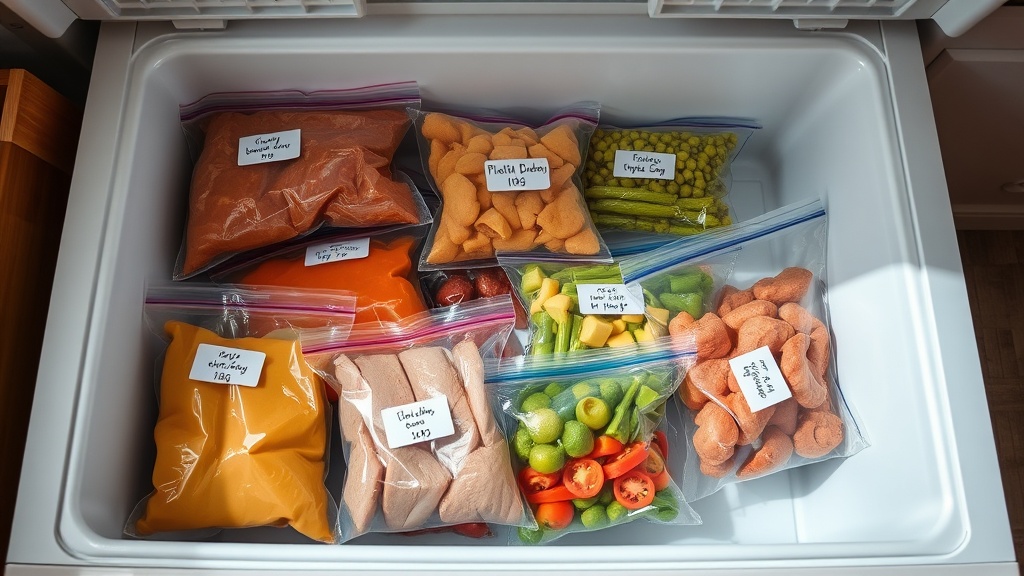
- Label everything. A piece of masking tape and a Sharpie. Date and contents. No exceptions. "Mystery bag from sometime in the fall" is how food gets wasted, not saved.
- First in, first out. New stuff goes to the back. This is literally how restaurant kitchens work and it's free to implement.
- The 3-month rule. If it's been in there longer than 3 months and you haven't touched it, it's not a savings—it's freezer clutter. Cook it this week or admit the mistake and move on.
- Flat freeze everything. Soups, sauces, marinated meat—freeze them flat in zip bags. They stack like files in a cabinet instead of becoming an avalanche every time you open the door.
But What About Freezer Burn?
Freezer burn is not a food safety issue—it's a texture and taste issue caused by air exposure. The fix is simple: squeeze every bit of air out of your bags before sealing. If you want to get serious, a $25 vacuum sealer from Aldi or Amazon pays for itself in about two weeks of proper freezer management. But honestly, the squeeze-and-seal method with regular zip bags works fine for 90% of applications.
The Bottom Line
Your freezer isn't a place where leftovers go to die. It's a financial tool. Used properly, it lets you buy at the lowest prices, cook at the most efficient scale, and waste almost nothing. That's the budget trifecta.
Stop scrolling past those markdown stickers. Stop throwing away the other half of that onion. Stop buying single-serve frozen meals at $4.50 a pop when you could batch-cook the same thing for a quarter of the price.
The spreadsheet doesn't lie: a well-managed freezer is worth $1,000+ a year in savings. That's not a lifestyle hack—that's math.